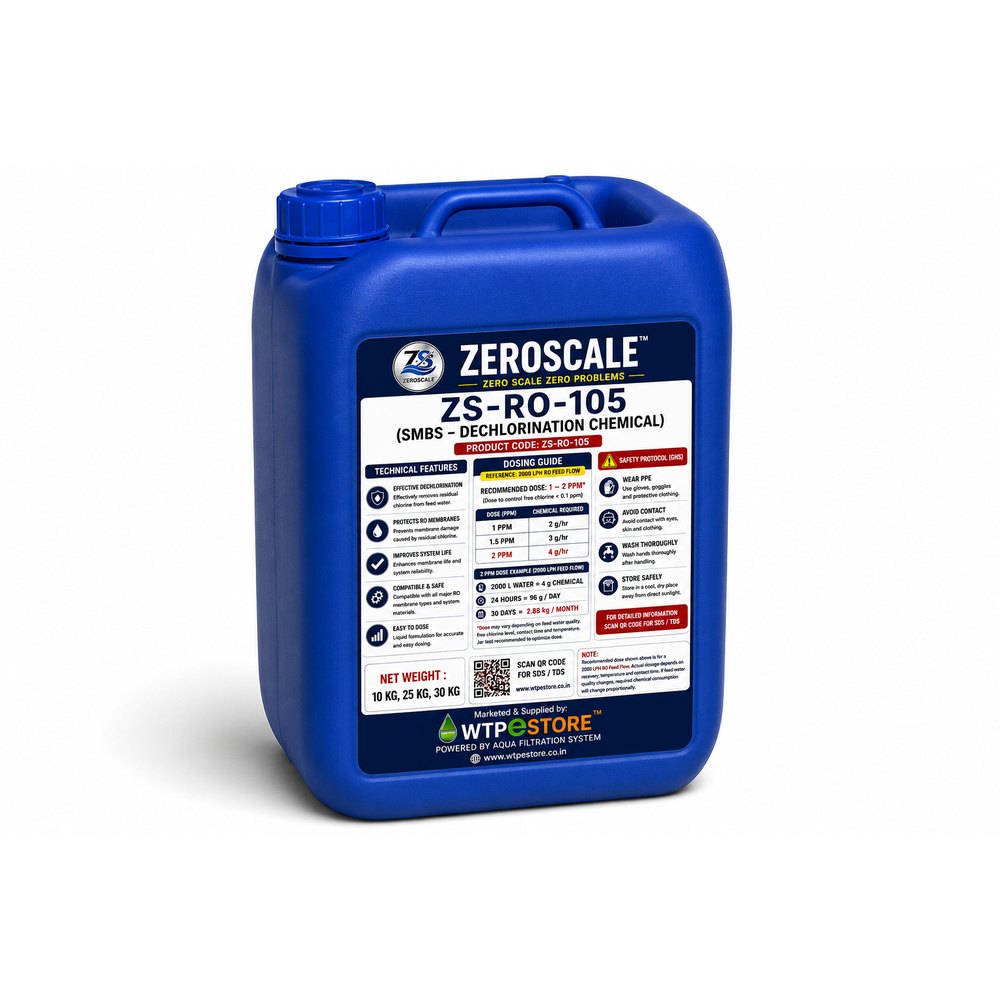
Sodium metabisulphite — the chemical that stands between chlorinated feed water and your RO membranes. It neutralises free chlorine before it reaches the polyamide layer, where even brief contact does permanent damage.
Municipal water is chlorinated by design, and many plants chlorinate their own raw water storage to control bacteria. That chlorine does a useful job right up until the point it reaches the membrane.
Thin-film composite membranes are built on a polyamide layer, and polyamide is oxidised by free chlorine. The damage is cumulative and permanent. A membrane exposed to chlorine keeps passing water — often at a higher flow than before, which fools operators into thinking nothing is wrong — but salt rejection falls away and never comes back. Product TDS rises and stays risen.
The industry measures this exposure in ppm-hours. It does not take a large dose; it takes time at a small dose. This is why continuous SMBS dosing matters more than most operators expect.
SMBS is a reducing agent. In water it forms sodium bisulphite, which reacts with free chlorine and converts it to harmless chloride:
SMBS is normally dosed after the activated carbon filter as a second line of defence, because carbon capacity for chlorine falls off as the media exhausts — often without warning.
| Parameter | Detail |
|---|---|
| Product code | ZS-RO-105 |
| Type | Sodium metabisulphite based reducing agent |
| Function | Neutralises residual free chlorine ahead of RO membranes |
| Dosage | As per residual chlorine — typically 3 mg SMBS per 1 mg free chlorine |
| Dosing point | After activated carbon filter, before cartridge filter |
| Target residual | Zero free chlorine at membrane inlet |
| Pack size | 25 kg · 50 kg |
| Storage | Cool, dry, sealed — SMBS solution loses strength on standing |
Approximate SMBS requirement — measure your actual free chlorine to confirm.
| Condition | Guideline |
|---|---|
| 0.2 ppm free chlorine | ≈ 0.6 ppm SMBS |
| 0.5 ppm free chlorine | ≈ 1.5 ppm SMBS |
| 1.0 ppm free chlorine | ≈ 3.0 ppm SMBS |
| 2.0 ppm free chlorine | ≈ 6.0 ppm SMBS |
| Municipal supply, variable | Dose for the peak, verify residual daily |
Any plant running on treated city supply, where residual chlorine is always present.
Where storage tanks are dosed with chlorine or bleaching powder for bacterial control.
Second line of defence for when activated carbon reaches the end of its capacity.
Where feed is chlorinated for safety but membranes must stay protected.
Roughly 3 mg of SMBS neutralises 1 mg of free chlorine. Most plants dose slightly above the calculated figure to hold a small margin against variation in the incoming supply.
After the activated carbon filter and before the cartridge filter. That order gives it enough contact time to react before water reaches the membranes.
Yes, in almost every case. Carbon removes chlorine well when fresh, but its capacity falls off gradually and there is no warning when it runs out. SMBS is the backstop that catches what gets past.
Test free chlorine at the membrane inlet daily. It should read zero. Any reading above zero means your dose is short or the solution has lost strength.
Every one to three days. SMBS solution degrades on contact with air. Keeping the dosing tank covered slows it down but does not stop it.
Test permeate TDS against the plant's baseline. A permanent rise in salt passage, especially with flow holding or rising, points to oxidation damage — cleaning will not recover it. Send us your figures and we will advise.
Send us your water analysis and system details — we will work out the dose rate, monthly consumption and price for you.
