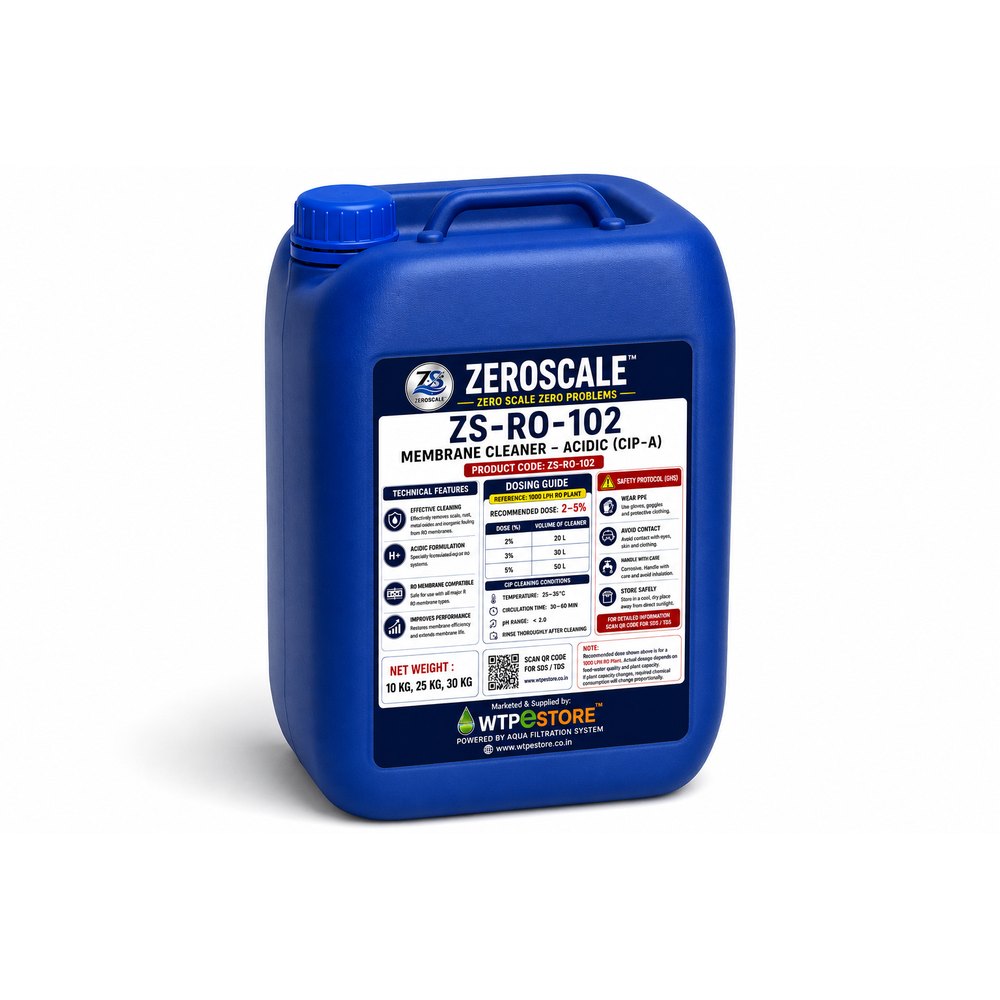
A low-pH clean-in-place chemical that dissolves the deposits antiscalant cannot prevent — carbonate scale, sulphate scale, iron and metal-oxide fouling — and brings membrane flow back up.
Even a well-dosed RO plant collects deposits over months. Acid cleaning is the answer to one specific family of them: inorganic fouling. That means calcium carbonate scale, calcium and barium sulphate, iron oxide from borewell water, and manganese deposits.
The signs are consistent. Permeate flow falls off while feed pressure has to be raised to hold it. Differential pressure across the stages climbs. Salt rejection slips. If your feed water carries iron, you may also see a reddish-brown tinge on the cartridge filters — the same deposits are sitting on the membrane behind them.
The rule of thumb across the industry: clean when normalised permeate flow drops 10–15%, when differential pressure rises 15%, or when salt passage increases 10%. Waiting past that point makes the deposits far harder to remove.
CIP-A works by lowering the pH of the cleaning solution so that alkaline deposits dissolve back into solution and flush out to drain:
Acid cleaning is always done before alkaline cleaning when both are needed — clearing the mineral layer first lets the alkaline stage reach the organic fouling underneath.
| Parameter | Detail |
|---|---|
| Product code | ZS-RO-102 |
| Type | Low-pH liquid membrane cleaner |
| Removes | CaCO₃ scale, sulphate scale, iron oxide, manganese, metal-oxide fouling |
| Cleaning pH | Typically 2–4 (as per CIP procedure) |
| Solution strength | 1–2% in RO permeate — confirm for your membrane |
| Cleaning temperature | Ambient to 35 °C (do not exceed membrane limit) |
| Pack size | 10 kg · 25 kg · 30 kg |
| Storage | Cool, dry, shaded — keep away from alkaline chemicals |
A general sequence — always follow your membrane manufacturer's limits on pH and temperature.
| Condition | Guideline |
|---|---|
| Step 1 — Prepare | Fill CIP tank with RO permeate, add cleaner to required strength |
| Step 2 — Low-flow recirculate | Circulate at low pressure for 15–30 minutes |
| Step 3 — Soak | Allow 1–8 hours depending on fouling severity |
| Step 4 — High-flow recirculate | Circulate 30–60 minutes to carry deposits away |
| Step 5 — Flush | Flush thoroughly with permeate until pH is neutral |
| Step 6 — Restart | Send permeate to drain until product TDS is normal |
Planned cleaning every 3–6 months on plants running hard or high-iron feed water.
Restoring permeate output on plants where flow has dropped 10–15% below normalised.
Feed water with iron above 0.1 ppm builds oxide deposits that only acid cleaning removes.
Cleaning membranes before preservation ahead of a long plant shutdown.
Clean when performance tells you to, not by the calendar: permeate flow down 10–15%, differential pressure up 15%, or salt passage up 10%. On typical borewell feed this works out to once every 3–6 months.
Acidic first when both are needed. The mineral layer sits on top; clearing it lets the alkaline stage reach organic fouling underneath. Flush thoroughly between the two stages.
RO permeate only. Making up a cleaning solution with raw feed water adds back the hardness you are trying to remove and can precipitate scale inside the membrane.
Light fouling needs 1 hour; heavy scaling may need overnight. If the solution turns cloudy or discoloured during soaking, drain it and make a fresh batch — it has reached its capacity.
Raw mineral acids are hard to control and can damage the membrane's thin-film layer at the concentrations people typically mix. A buffered formulated cleaner works at controlled pH and includes chelating agents that plain acid does not have.
If your feed carries organics, biofilm or colloidal matter — most surface water and many borewells — then yes. Acid alone will not lift organic fouling.
Send us your water analysis and system details — we will work out the dose rate, monthly consumption and price for you.
