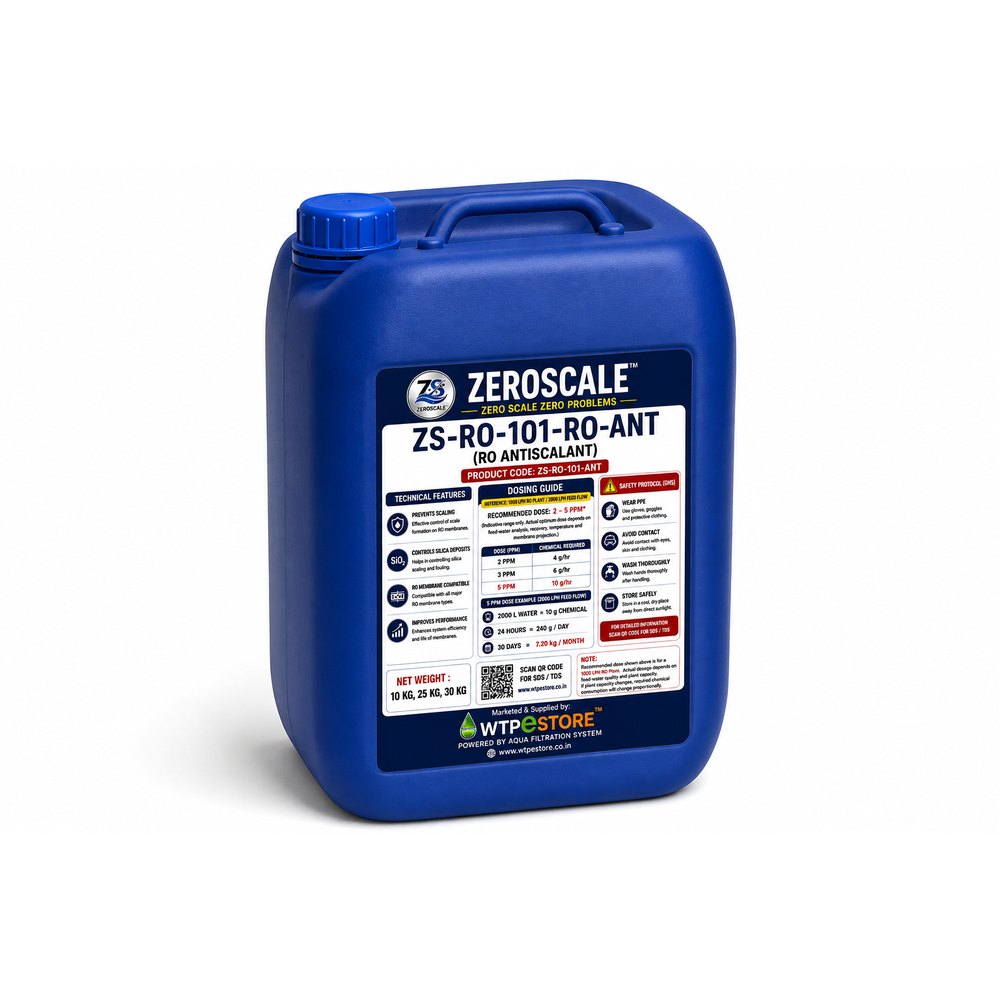
A liquid polymer antiscalant that keeps calcium carbonate, calcium sulphate, barium sulphate and silica from crystallising on your RO membrane surface — so flow stays steady and membranes last their full life.
Every borewell or municipal feed water carries dissolved calcium, magnesium, barium and silica. Inside an RO membrane roughly 60–75% of that water passes through as permeate — but the salts do not. They stay behind in the shrinking reject stream, and their concentration climbs until they cross their solubility limit and start forming crystals directly on the membrane surface.
Once that layer forms, three things follow in order: permeate flow drops, reject pressure climbs, and salt rejection falls so your product TDS rises. Operators usually notice the TDS first — by then the scale has been growing for a while. Hard scale that has bonded to the membrane often cannot be fully cleaned off, so the membrane is permanently down on output.
Antiscalant is what stops that sequence from starting.
ZS-RO-101 is a blend of dispersant polymers and threshold inhibitors. It does not remove hardness from the water — it interferes with crystal formation at a chemical level:
The practical result is a longer run between CIP cleanings, steadier permeate output, and membranes that reach their rated life instead of being replaced early.
| Parameter | Detail |
|---|---|
| Product code | ZS-RO-101 |
| Type | Liquid polymer blend antiscalant |
| Controls | CaCO₃, CaSO₄, BaSO₄, SrSO₄, silica (SiO₂), iron fouling |
| Dosage | 2–5 ppm on feed water |
| Dosing point | After cartridge filter, before high pressure pump |
| Pack size | 10 kg · 25 kg · 30 kg |
| Membrane compatibility | Suitable for thin-film composite (TFC) membranes |
| Storage | Cool, dry, shaded area — away from direct sunlight |
A starting point — final dose should follow a feed water analysis.
| Condition | Guideline |
|---|---|
| Low TDS (below 500 ppm), soft feed | 2 ppm |
| Normal borewell, hardness up to 300 ppm | 3 ppm |
| High hardness (300–600 ppm) | 4 ppm |
| High silica or high barium feed | 4–5 ppm |
| Recovery above 75% | 4–5 ppm |
Textile, dyeing, automobile, electroplating and general manufacturing units running 500 LPH to 50,000 LPH.
Bottling and water ATM plants where consistent permeate TDS decides product quality.
Pre-treatment ahead of DM or mixed-bed polishing, where membrane downtime stops the whole line.
Commercial RO systems on hard borewell feed, where scaling is the usual cause of dropping output.
2 to 5 ppm on feed water. Low-TDS feed sits at the 2–3 ppm end; high hardness, high silica or high recovery pushes you to 4–5 ppm. Share your water report and we will confirm the figure for your plant.
Both work. Neat dosing is fine, but most plants dilute in the dosing tank so the pump runs at a workable stroke setting. Always dilute with RO permeate or soft water — raw hard water in the dosing tank defeats the purpose.
After the cartridge filter and before the high pressure pump. That gives the chemical time to mix fully with the feed before it reaches the membrane.
Scale begins forming within days on hard feed water. You will see permeate flow drop and reject pressure rise first. Restart dosing immediately and plan a CIP — a scaled membrane left untreated does not fully recover.
Yes, at recommended dose levels. The antiscalant leaves with the reject stream and is not carried into permeate.
Yes — antiscalant stretches the interval between cleanings, it does not replace them. Keep acidic and alkaline CIP chemicals on hand for scheduled cleaning.
Send us your water analysis and system details — we will work out the dose rate, monthly consumption and price for you.
