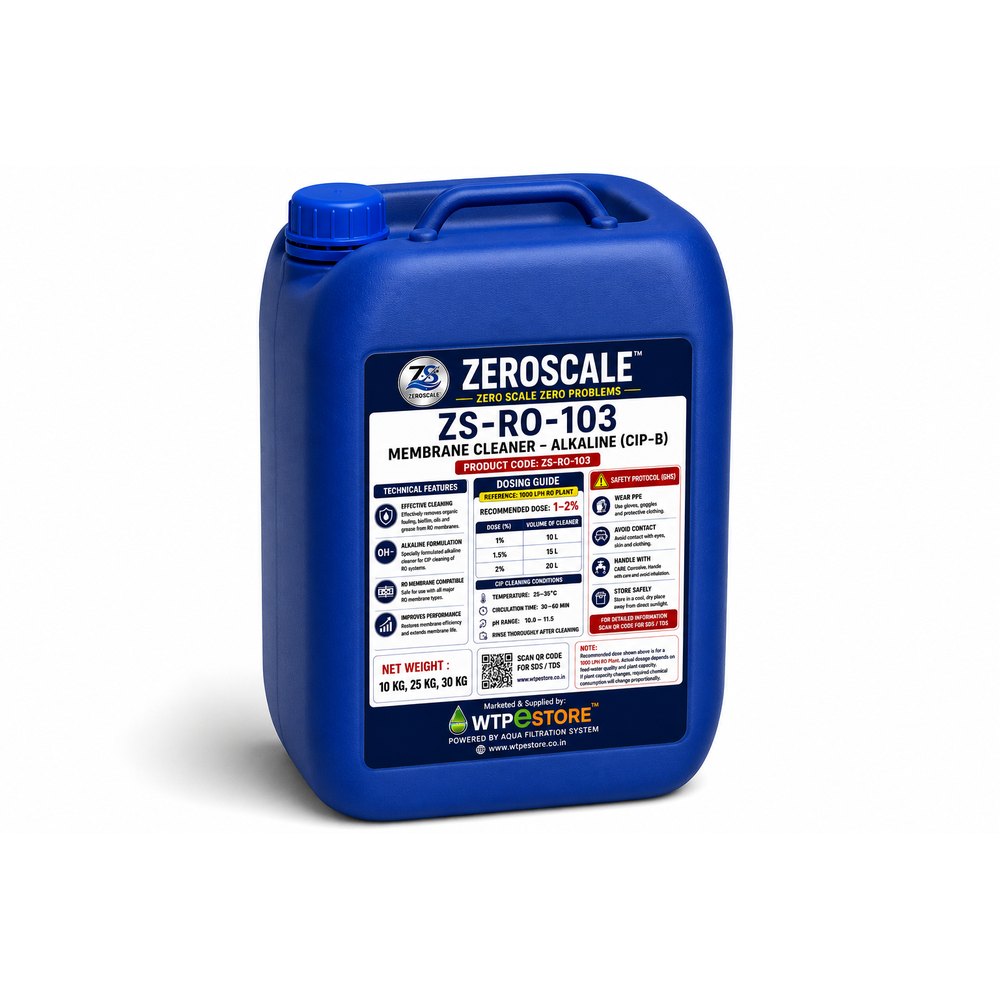
A high-pH clean-in-place chemical for the fouling acid cannot touch — organic matter, biofilm, slime and colloidal deposits that build a slippery layer across the membrane surface.
Organic fouling behaves differently from scale. Instead of hard crystals, it forms a soft, slippery film across the membrane — bacteria, extracellular slime, oils, humic matter from surface water and fine colloidal clay all bind together into a layer that water has to push through.
The tell-tale signature is a sharp rise in differential pressure across the first stage while salt rejection stays reasonably good. Scale usually hits the last stage hardest because that is where salts concentrate; biofilm hits the first stage, where nutrients enter.
Biofilm is also self-renewing. Any bacteria left behind after a partial clean multiply again within days, which is why organic fouling seems to come back faster each time if it is not fully removed.
CIP-B raises the pH of the cleaning solution, which breaks down organic material and lifts it off the membrane:
For plants that foul both ways — mineral and organic — run the acidic clean first, flush thoroughly, then run this alkaline stage.
| Parameter | Detail |
|---|---|
| Product code | ZS-RO-103 |
| Type | High-pH liquid membrane cleaner |
| Removes | Organic matter, biofilm, slime, oils, colloidal and silt fouling |
| Cleaning pH | Typically 10–12 (as per CIP procedure) |
| Solution strength | 1–2% in RO permeate — confirm for your membrane |
| Cleaning temperature | Ambient to 35 °C (do not exceed membrane limit) |
| Pack size | 10 kg · 25 kg · 30 kg |
| Storage | Cool, dry, shaded — keep away from acidic chemicals |
A general sequence — always follow your membrane manufacturer's limits on pH and temperature.
| Condition | Guideline |
|---|---|
| Step 1 — Prepare | Fill CIP tank with RO permeate, add cleaner to required strength |
| Step 2 — Low-flow recirculate | Circulate at low pressure for 15–30 minutes |
| Step 3 — Soak | 1–8 hours; heavy biofilm benefits from an overnight soak |
| Step 4 — High-flow recirculate | Circulate 30–60 minutes to carry loosened film away |
| Step 5 — Flush | Flush with permeate until pH returns to neutral |
| Step 6 — Restart | Send permeate to drain until product TDS is normal |
River, canal and lake feed carrying humic matter and high organic load.
Process water systems where sugars and organics enter the feed stream.
Treated effluent recycling, where organic and colloidal fouling is the main problem.
Any plant where differential pressure climbs while salt rejection holds — a biofilm signature.
Look at where the pressure rises. Rising differential pressure in the first stage with rejection holding usually means organic fouling — use alkaline. Falling flow with rising salt passage in the last stage points to scale — use acidic. When in doubt, or when both symptoms appear, run acid first then alkaline.
Never. They neutralise each other and can react. Run them as separate stages with a thorough permeate flush in between.
1 hour for light fouling. Established biofilm needs longer — many plants soak overnight and then run the high-flow stage in the morning.
Because bacteria left behind multiply. Repeat fouling within weeks means the source is upstream: check for stagnant storage, exhausted carbon media or dead-legs in piping, and consider a periodic biocide dose.
It suits standard thin-film composite membranes at recommended strength and temperature. Confirm your membrane's maximum pH and temperature before cleaning — send us the model if you are not sure.
UF cleaning follows a different procedure and different limits. Tell us your UF module and we will recommend the right chemical and sequence.
Send us your water analysis and system details — we will work out the dose rate, monthly consumption and price for you.
