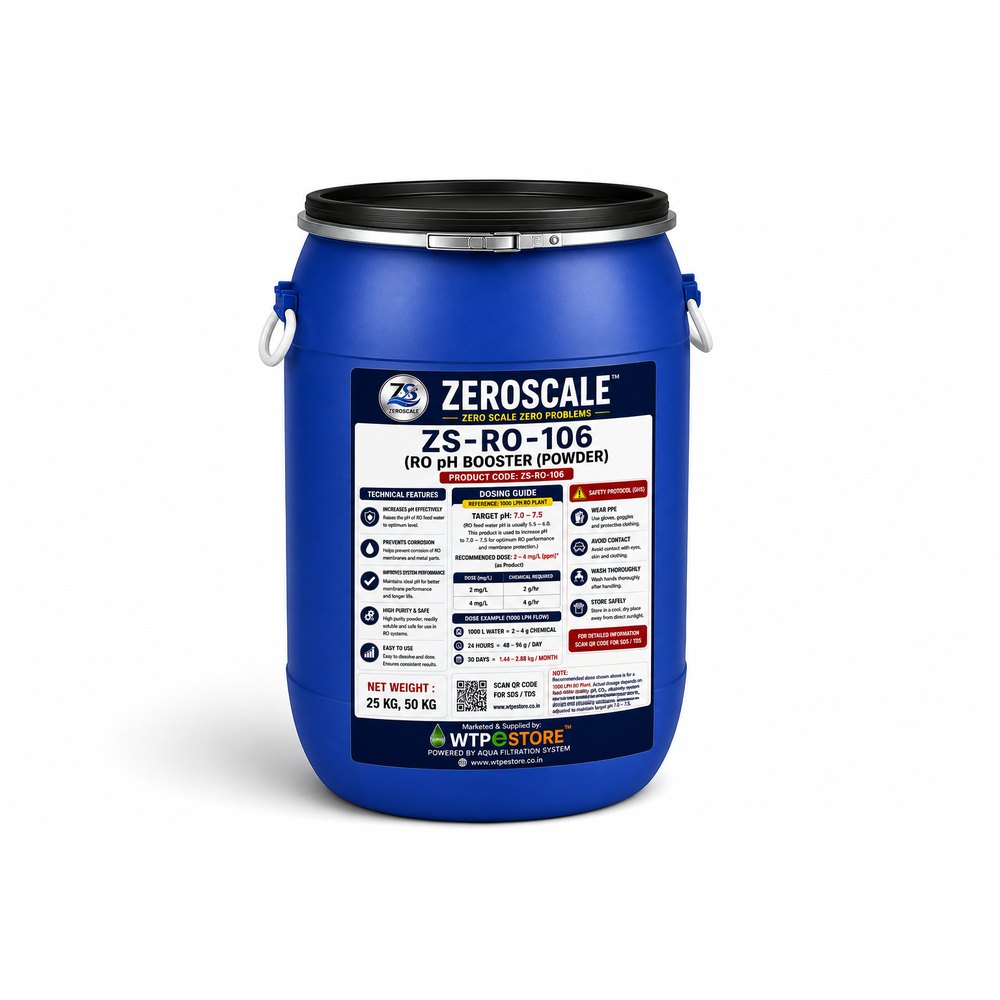
A high-purity sodium carbonate powder for correcting pH — raising acidic feed water into a safe range, and lifting permeate pH so RO water stops corroding the pipes and tanks it flows into.
RO does its job well: it strips out dissolved salts. But the same process removes the natural alkalinity that keeps water chemically stable. Permeate typically comes out mildly acidic and with almost no buffering capacity, which makes it aggressive towards metal.
In practice that shows up as pinhole leaks in mild steel and copper lines, corroded storage tank fittings, blue-green staining on brass and copper, and metallic taste in stored water. Plants often replace the piping and see the same failure repeat two years later, without connecting it to the water chemistry.
The second use is on the feed side. Some borewell water is naturally acidic, and low-pH feed both corrodes the pre-treatment equipment and pushes the RO to run outside its optimum range.
Sodium carbonate dissolves to give a stable alkaline solution that lifts pH and restores buffering:
It is supplied as a powder, dissolved in the dosing tank and injected through a standard metering pump — the same setup you already use for antiscalant.
| Parameter | Detail |
|---|---|
| Product code | ZS-RO-106 |
| Type | High-purity alkaline powder (sodium carbonate based) |
| Function | Raises pH of feed or permeate water; restores alkalinity |
| Dosage | Typically 5–25 ppm, as per required pH correction |
| Preparation | Dissolve in dosing tank; dose through metering pump |
| Dosing point | Feed line, or permeate line before storage |
| Pack size | 25 kg · 50 kg bag |
| Storage | Dry area — keep bags sealed, powder absorbs moisture |
Starting points — always confirm by measuring pH after dosing.
| Condition | Guideline |
|---|---|
| Permeate pH 5.5–6.0, target 7.0 | 10–15 ppm |
| Permeate pH 6.0–6.5, target 7.0 | 5–10 ppm |
| Acidic borewell feed correction | 15–25 ppm |
| Packaged drinking water, taste correction | As per required alkalinity |
| Boiler make-up water pre-correction | Per boiler water specification |
Correcting permeate pH and alkalinity so bottled water meets specification and tastes right.
Any RO installation where permeate runs through mild steel, copper or brass lines.
Pre-correcting RO permeate before it enters the boiler feed system.
Raising low-pH raw water into a workable range ahead of treatment.
RO removes the alkalinity that normally buffers water, leaving it mildly acidic and aggressive towards metal. It is the low pH and absent buffering, not any impurity, that causes the corrosion.
It depends on your starting pH and flow. A typical permeate at pH 6.0 needs roughly 10–15 ppm. Measure after dosing and adjust — send us your figures and we will calculate the setting.
Caustic soda works but is harsh to handle and moves pH sharply, so it is easy to overshoot. Sodium carbonate lifts pH gradually and adds buffering capacity, which caustic does not.
Into the permeate line before storage for corrosion control, or into the feed line when correcting acidic raw water. The two applications need different dose points and rates.
Sodium carbonate is used routinely in drinking water treatment at these levels. Use food-grade material for potable applications and confirm the grade when ordering.
Almost always undissolved powder blocking the pump suction, or a solution that has settled out in the tank. Drain, mix a fresh batch with full dissolution, and stir before each shift.
Send us your water analysis and system details — we will work out the dose rate, monthly consumption and price for you.
