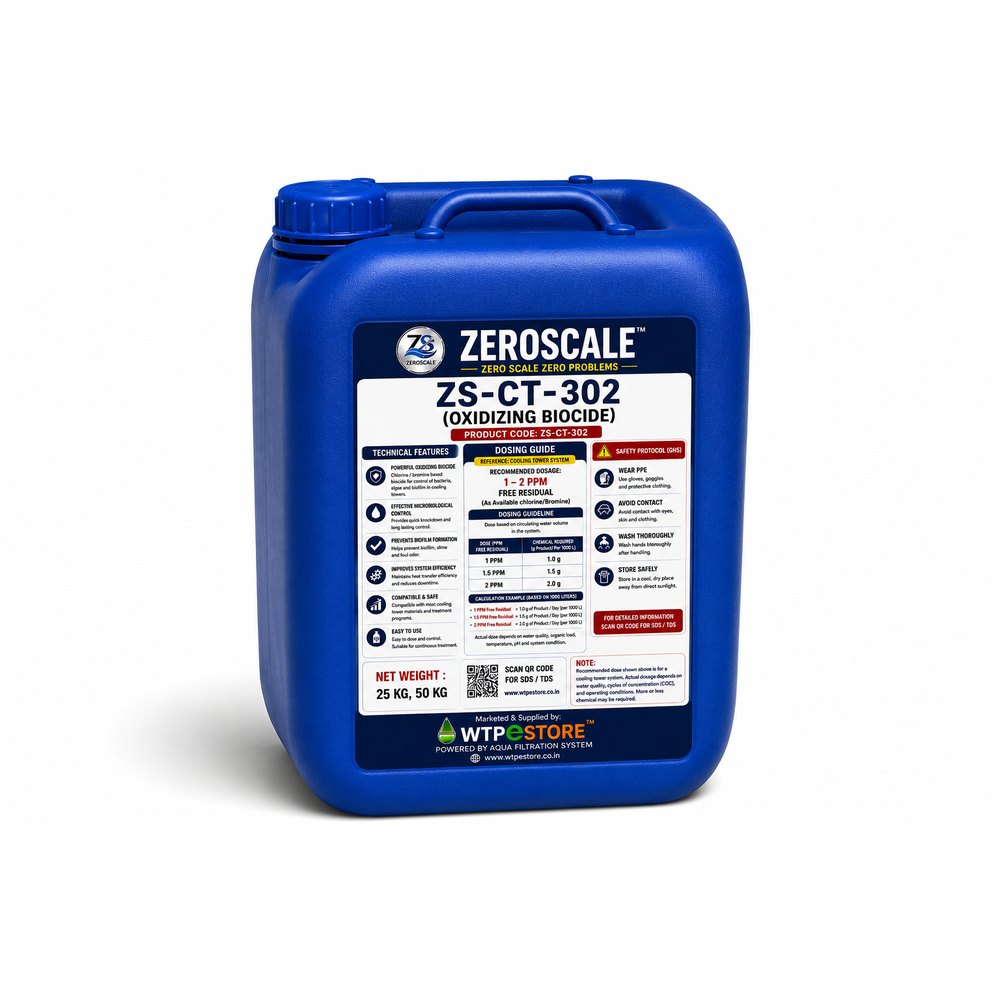
A chlorine and bromine based biocide for continuous microbiological control. A cooling tower is warm, wet, aerated and open to the air — the conditions bacteria and algae need, all supplied at once.
A cooling tower is close to a purpose-built incubator. Water sits in the ideal temperature band, it is fully aerated, sunlight reaches the basin, and air drawn through the tower delivers a continuous supply of airborne organisms, dust and nutrients.
The visible result is algae — green growth on the basin walls and distribution deck. The costly result is invisible: biofilm forming inside heat exchanger tubes, where it insulates far more effectively than mineral scale. A biofilm layer a fraction of a millimetre thick can cut heat transfer more than a scale layer several times thicker.
Biofilm also shelters corrosion. Under-deposit corrosion develops beneath the film where inhibitors cannot reach, so a biologically fouled system corrodes faster even when the corrosion programme is otherwise correct.
Oxidising biocides kill on contact by attacking cell structure directly:
Oxidising biocide handles routine day-to-day control. It is normally alternated with a non-oxidising biocide, because organisms sheltered inside established biofilm need a different mode of attack.
| Parameter | Detail |
|---|---|
| Product code | ZS-CT-302 |
| Type | Chlorine / bromine based oxidising biocide |
| Controls | Bacteria, algae, fungi, biofilm-forming organisms |
| Dosage | Maintain 1–2 ppm free residual |
| Dosing point | Cooling tower basin or circulating line |
| Control test | Free residual in circulating water |
| Pack size | 25 kg · 50 kg |
| Storage | Cool, dry, shaded — keep away from acids and reducing agents |
Set the actual dose by measuring free residual in the circulating water.
| Condition | Guideline |
|---|---|
| Free residual target | 1–2 ppm in circulating water |
| Clean system, low load | Lower end of range |
| Visible algae or high organic load | Upper end, plus shock dosing |
| Testing frequency | Daily where possible; weekly minimum |
| Programme | Alternate with non-oxidising biocide for biofilm control |
Standard routine control for industrial and commercial cooling systems.
Building cooling systems where public health and hygiene requirements apply.
Basin and deck growth calls for shock dosing followed by a maintained residual.
Where process leaks add nutrients that accelerate microbial growth.
1 to 2 ppm free residual in the circulating water. Test it regularly — a residual reading of zero means the biocide has been fully consumed and the system is unprotected between doses.
Most systems dose continuously or on a timed cycle to hold the residual. Systems with heavy fouling start with shock dosing to knock the population down, then move to maintenance dosing.
Both, alternating. Oxidising handles routine control; non-oxidising penetrates established biofilm that oxidising biocide cannot reach. Alternating also prevents organisms adapting to a single chemistry.
Shock dosing kills it, but dead algae needs physically removing from the basin — otherwise it decays and feeds the next growth cycle. Clean the basin after the shock dose.
They work as a programme, but dose them separately rather than mixing in one tank. Tell us your system and we will lay out the dosing points and sequence.
Microbiological control is part of managing that risk, alongside system design, temperature control and regular cleaning. Tell us your installation type and we will advise on the programme.
Send us your water analysis and system details — we will work out the dose rate, monthly consumption and price for you.
