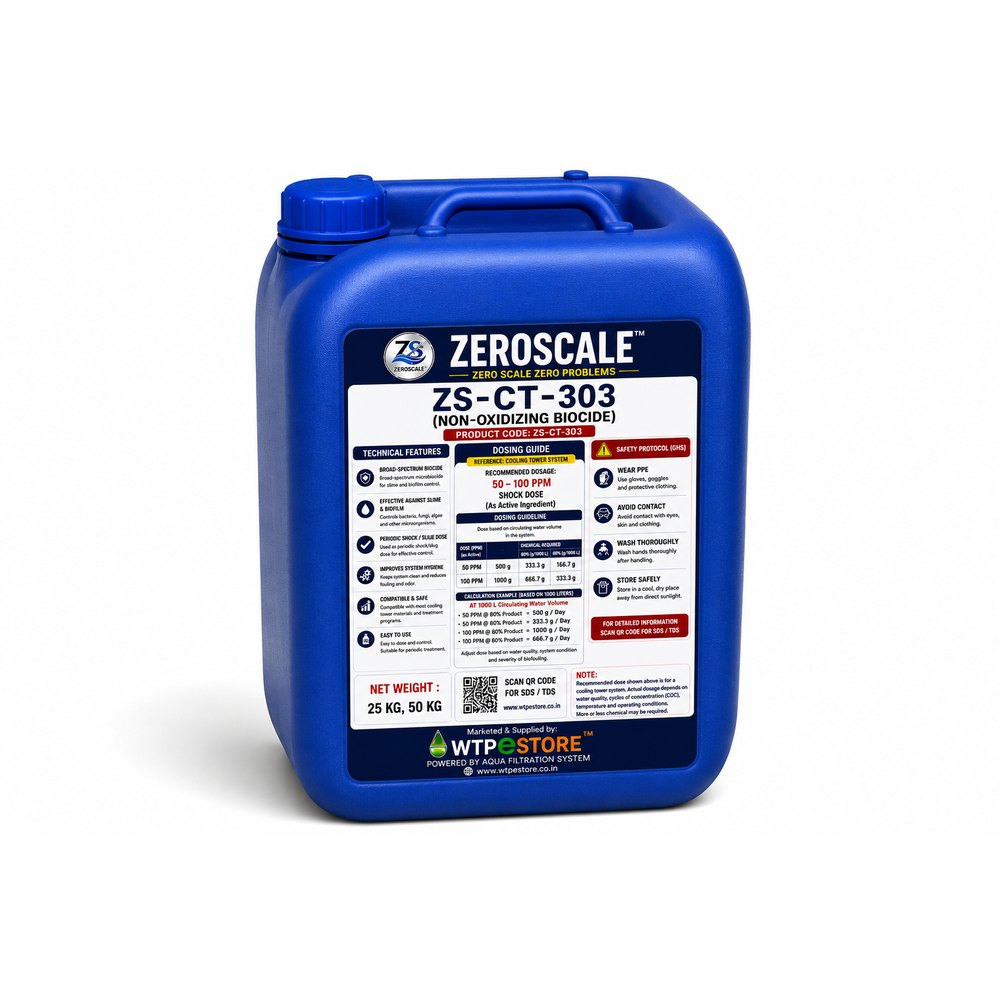
A broad-spectrum biocide for the organisms oxidising chemicals cannot reach — the ones sheltering inside established slime and biofilm layers. Used as a periodic shock dose alongside your routine programme.
Oxidising biocide works on contact, which is its strength and its limit. Bacteria living inside an established slime layer are physically shielded — the oxidising chemical is consumed by the outer surface of the film before it reaches the colony underneath.
That is why a system with good free residual readings can still show rising bacterial counts and worsening heat transfer. The measurement says the water is treated; the film says otherwise.
A second issue is adaptation. Populations exposed to only one chemistry over long periods become progressively harder to control with it. Alternating chemistries is standard practice for this reason.
Non-oxidising biocides work by a different mechanism, which is precisely the point:
Used as a slug dose — the full quantity added at once to reach an effective concentration quickly — typically alternated with the oxidising biocide on a weekly or fortnightly cycle.
| Parameter | Detail |
|---|---|
| Product code | ZS-CT-303 |
| Type | Broad-spectrum non-oxidising liquid microbiocide |
| Controls | Slime-forming bacteria, fungi, biofilm |
| Dosage | 50–100 ppm as shock / slug dose |
| Dosing point | Cooling tower basin, added as a slug |
| Programme | Alternate with oxidising biocide |
| Pack size | 25 kg · 50 kg |
| Storage | Cool, dry, shaded — keep container tightly closed |
Slug dosing — the whole quantity at once, not fed continuously.
| Condition | Guideline |
|---|---|
| Routine alternation | 50 ppm, weekly or fortnightly |
| Visible slime or high counts | 75–100 ppm |
| After system cleaning | 100 ppm to knock down the surviving population |
| Dose timing | Add to basin with blowdown closed for the contact period |
| Contact period | Hold circulation without blowdown for the recommended time |
Where oxidising biocide alone has not controlled biofilm formation.
Standard practice — alternating chemistries to prevent adaptation.
After mechanical cleaning of a tower, to control the surviving population.
Where process leaks or organic contamination feed rapid microbial growth.
Weekly or fortnightly for most systems, alternating with the oxidising biocide. Systems with heavy fouling start more frequently and extend the interval as counts come down.
Oxidising biocide is consumed at the surface of a biofilm and does not reach organisms inside it. Non-oxidising chemistry penetrates the film. Alternating also stops populations adapting to a single chemistry.
Yes, for the contact period. Otherwise the dose is diluted before it can act, which is the usual reason a shock dose appears to fail.
Heat transfer falling while scale and corrosion readings look normal is the usual signature. Slime on the basin walls or tower fill confirms it visually. Bacterial counts give the clearest measure.
No — dose them at separate times as an alternating programme. Mixing works against both.
It depends on system volume, not tower size alone. Send us your holding capacity — basin plus piping plus exchangers — and we will calculate the slug dose quantity.
Send us your water analysis and system details — we will work out the dose rate, monthly consumption and price for you.
