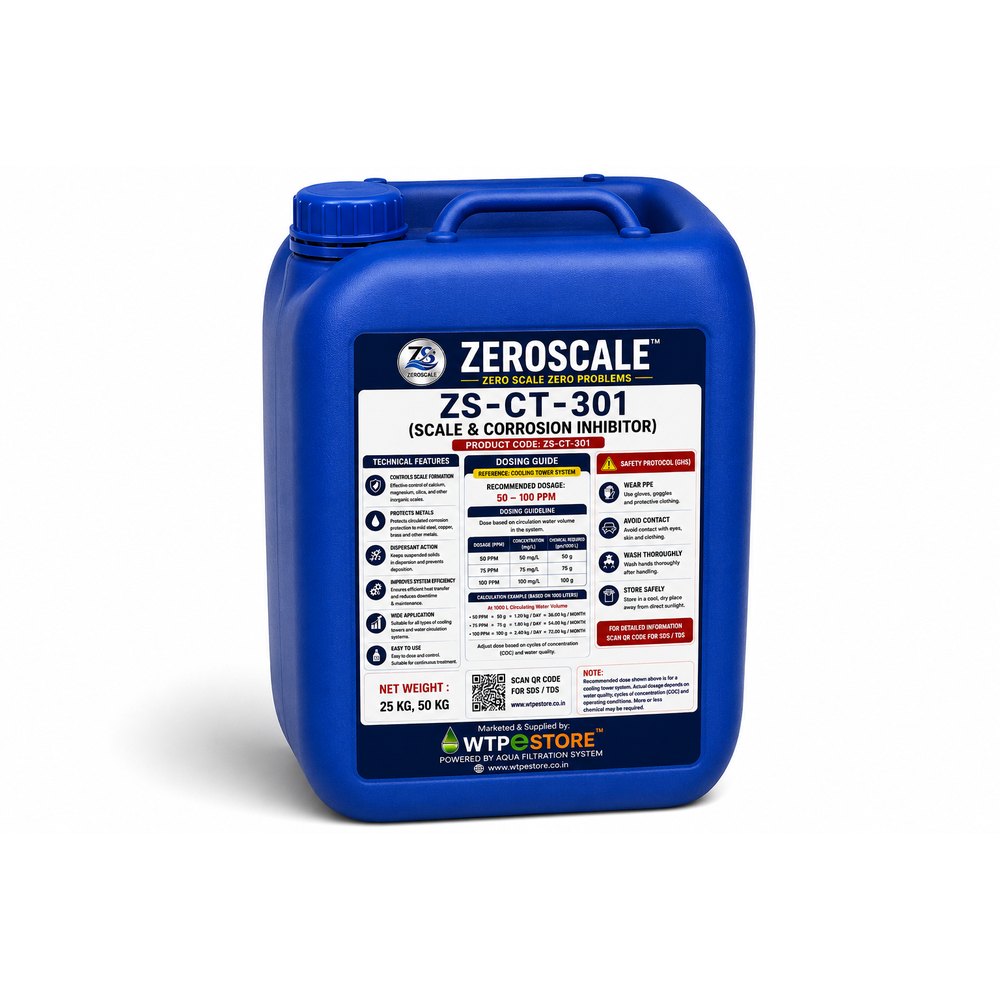
Cooling water concentrates as it evaporates, and that concentration drives both scale and corrosion at the same time. This single formulation handles both across the circuit — tower fill, heat exchangers, chillers and piping.
A cooling tower works by evaporating water. The dissolved salts do not evaporate with it — they stay behind and concentrate cycle after cycle. Calcium carbonate is the first to reach saturation, and it deposits exactly where it hurts most: on the hot heat-exchanger surfaces where transfer efficiency matters.
At the same time the water is fully aerated by design — it has just been sprayed through air — so it is oxygen-saturated and corrosive to the mild steel and copper in the circuit. Pitting develops in the tubes, and corrosion products circulate and settle as deposits of their own.
The two problems interact. Deposits create oxygen-concentration cells underneath, accelerating localised corrosion. Corrosion debris gives scale somewhere to anchor. Treating one without the other rarely holds.
The formulation carries several actives working on different parts of the problem:
Chemical treatment works alongside cycle control, not instead of it. Blowdown sets how far the water concentrates; the chemical protects the system within that range.
| Parameter | Detail |
|---|---|
| Product code | ZS-CT-301 |
| Type | Multi-functional liquid cooling water treatment |
| Controls | Calcium carbonate and sulphate scale, mild steel and yellow metal corrosion |
| Dosage | 50–100 ppm on circulating water |
| Dosing point | Cooling tower basin or circulating line |
| Control tests | Conductivity, hardness, pH, inhibitor residual |
| Pack size | 25 kg · 50 kg |
| Storage | Cool, dry, shaded — keep container closed |
Starting figures — set final values against your make-up water analysis.
| Condition | Guideline |
|---|---|
| Low-hardness make-up, low cycles | 50 ppm |
| Normal borewell make-up | 60–80 ppm |
| Hard make-up or high cycles | 80–100 ppm |
| Cycles of concentration | Typically 3–5, set by make-up quality |
| Blowdown control | By conductivity, against the cycle target |
Chemical, pharmaceutical, plastics and general manufacturing cooling circuits.
Commercial buildings, malls, hospitals and hotels running centralised chilled water.
Where fouled exchangers show up immediately as reduced capacity.
High heat flux surfaces where even thin scale causes rapid problems.
50–100 ppm on circulating water, set by make-up hardness and your cycles of concentration. Send us the make-up water report and system volume and we will work out the dose and top-up rate.
How many times the circulating water has concentrated relative to make-up. Measure conductivity of both and divide. Higher cycles save water but increase scaling risk.
Approach temperature rising across the heat exchanger for the same load is the clearest early sign. Confirm by inspecting exchanger tubes or tower fill at the next shutdown.
No — that needs a biocide. Scale, corrosion and microbiological control are three separate jobs and a full programme covers all three.
Conductivity and inhibitor residual at least weekly; pH and hardness alongside. Systems on variable load or with automatic blowdown benefit from more frequent checks.
No. Without blowdown the water concentrates without limit and will scale regardless of chemical dose. Blowdown is what sets the ceiling the treatment works within.
Send us your water analysis and system details — we will work out the dose rate, monthly consumption and price for you.
