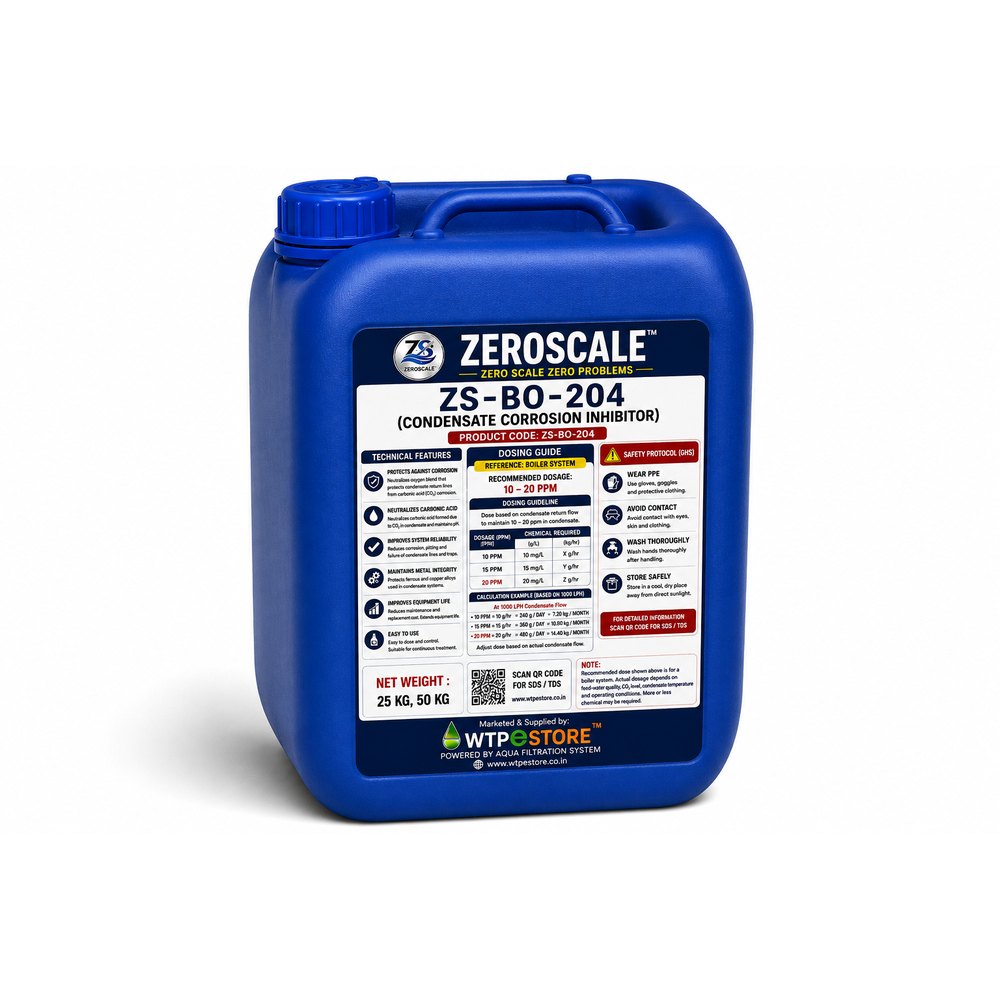
A neutralising amine blend that travels with the steam and protects the return lines. Carbonic acid corrosion works quietly on the inside of condensate piping until the first pinhole leak announces it.
Bicarbonate alkalinity in boiler feed water breaks down at boiler temperature and releases carbon dioxide. That CO₂ leaves with the steam, and when the steam condenses in the return lines, it dissolves into the condensate as carbonic acid.
The result is a low-pH condensate flowing through carbon steel piping. The corrosion it causes is characteristic — grooving along the bottom of horizontal runs where condensate collects, and general thinning elsewhere. Traps and fittings go first.
It also feeds a second problem. Corroded condensate carries iron back to the boiler, where it deposits on heat-transfer surfaces. So a neglected condensate system quietly creates a boiler deposit problem at the same time as it destroys the piping.
Neutralising amines are volatile, which is what makes them work — they distribute with the steam and reach the whole return system:
Protecting condensate also protects the boiler: clean returns mean less iron coming back to deposit on heat-transfer surfaces, and more usable condensate returned means less fresh make-up to treat.
| Parameter | Detail |
|---|---|
| Product code | ZS-BO-204 |
| Type | Neutralising amine blend, liquid |
| Function | Protects condensate return lines from carbonic acid corrosion |
| Dosage | 10–20 ppm |
| Dosing point | Feed water line or steam header |
| Control test | Condensate pH at return points |
| Pack size | 25 kg · 50 kg |
| Storage | Cool, dry, shaded — keep container tightly closed |
Set the final dose by measuring condensate pH at the return points.
| Condition | Guideline |
|---|---|
| Low feed alkalinity, short return lines | 10 ppm |
| Moderate alkalinity, normal system | 12–15 ppm |
| High feed alkalinity (high CO₂ generation) | 15–20 ppm |
| Long or branched return network | Upper end — distant legs need more |
| Control target | Condensate pH in the non-corrosive range at the furthest return point |
Any system returning condensate to the boiler feed tank — the standard case.
Where returns run through the plant and distant legs are hardest to protect.
Where more bicarbonate means more CO₂ generated in the boiler.
Where return line failures keep recurring after replacement.
10–20 ppm, set by your feed water alkalinity and the length of the return system. Confirm by measuring condensate pH at the furthest return point, not the closest.
Into the feed water line or directly to the steam header. Feed line dosing is the usual arrangement and simpler to control.
Test condensate pH — a low reading confirms carbonic acid. Physically, look for grooving along the bottom of horizontal runs, and iron in the returned condensate.
Where steam touches food or pharmaceutical product, the amine must be an approved grade at approved levels. Tell us your application and we will confirm the right product and dose.
Because the cause was never addressed. New pipe in acidic condensate corrodes the same way. Treat the condensate chemistry and the replacement lasts.
No — different problems. Amine neutralises carbonic acid in condensate; the scavenger removes dissolved oxygen from feed water. Most plants need both.
Send us your water analysis and system details — we will work out the dose rate, monthly consumption and price for you.
