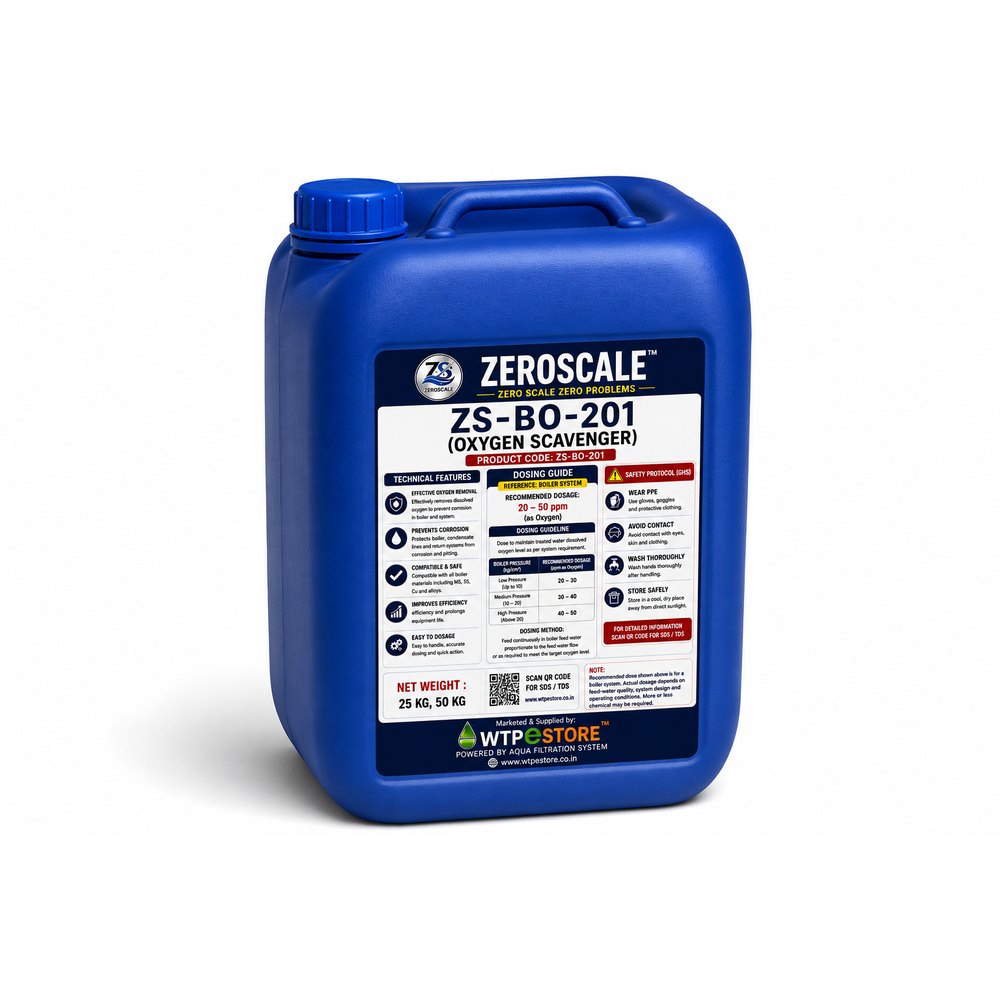
A sulphite and amine based scavenger that strips dissolved oxygen out of boiler feed water — the single most effective step against the pitting corrosion that eats through boiler tubes from the inside.
Cold water holds a surprising amount of dissolved oxygen. Heat it inside a boiler and that oxygen comes out of solution and attacks the steel — not evenly across the surface, but at concentrated points. The result is pitting: deep, narrow holes that penetrate tube walls while the surrounding metal still looks sound.
This is what makes oxygen corrosion dangerous. General corrosion thins a tube gradually and gives you warning. Pitting drills through at a single point, and a tube can fail from a pit while a thickness survey elsewhere reads perfectly acceptable.
Oxygen enters through the make-up water, and through any air leaking into the condensate return system — which is why plants with long return lines and old fittings usually have a bigger oxygen problem than they expect.
The scavenger reacts chemically with dissolved oxygen so it can no longer attack metal:
Dosing goes into the feed tank or feed line, ahead of the boiler. Where a deaerator is fitted, the scavenger handles the residual oxygen the deaerator cannot remove mechanically.
| Parameter | Detail |
|---|---|
| Product code | ZS-BO-201 |
| Type | Sulphite / amine based liquid oxygen scavenger |
| Function | Removes dissolved oxygen from boiler feed water |
| Dosage | Approximately 3× dissolved oxygen concentration (ppm) |
| Dosing point | Feed water tank or feed line, ahead of the boiler |
| Control test | Maintain a residual sulphite level in boiler water |
| Pack size | 25 kg · 50 kg |
| Storage | Cool, dry, shaded — keep container closed |
Approximate starting figures — confirm against your feed water test.
| Condition | Guideline |
|---|---|
| Deaerated feed, 0.02 ppm O₂ | ≈ 0.06 ppm scavenger |
| Partially deaerated, 0.1 ppm O₂ | ≈ 0.3 ppm scavenger |
| Hot feed tank, 0.5 ppm O₂ | ≈ 1.5 ppm scavenger |
| Cold make-up, 2.0 ppm O₂ | ≈ 6.0 ppm scavenger |
| Plus residual | Add enough to hold a measurable sulphite residual in boiler water |
Package and industrial boilers across food, textile, pharma, chemical and processing plants.
Where feed water is not deaerated, oxygen load is highest and scavenging matters most.
Systems where air leaks into return lines through old fittings and vents.
Boilers held on hot standby, where oxygen ingress continues without steam demand.
Roughly three times the dissolved oxygen concentration in ppm, plus enough to hold a residual in the boiler water. Send us your feed water oxygen figure and boiler capacity and we will calculate the daily quantity.
Into the feed water tank or feed line before the boiler. Dosing into the feed tank gives more reaction time, which helps at lower temperatures.
Yes. A deaerator removes most oxygen mechanically but always leaves a residual, and that residual is enough to pit tubes over time. The scavenger handles what the deaerator leaves behind.
Test for sulphite residual in the boiler water. A consistent measurable residual means you are covering the oxygen load; zero residual means you are dosing short.
Deep, round, localised pits with the surrounding metal relatively unaffected, often under a small dark deposit. That pattern distinguishes it from general acid corrosion, which thins the surface evenly.
Yes, they do different jobs and are used together. Dose them separately rather than mixing in one tank — send us your boiler details and we will lay out the full programme.
Send us your water analysis and system details — we will work out the dose rate, monthly consumption and price for you.
