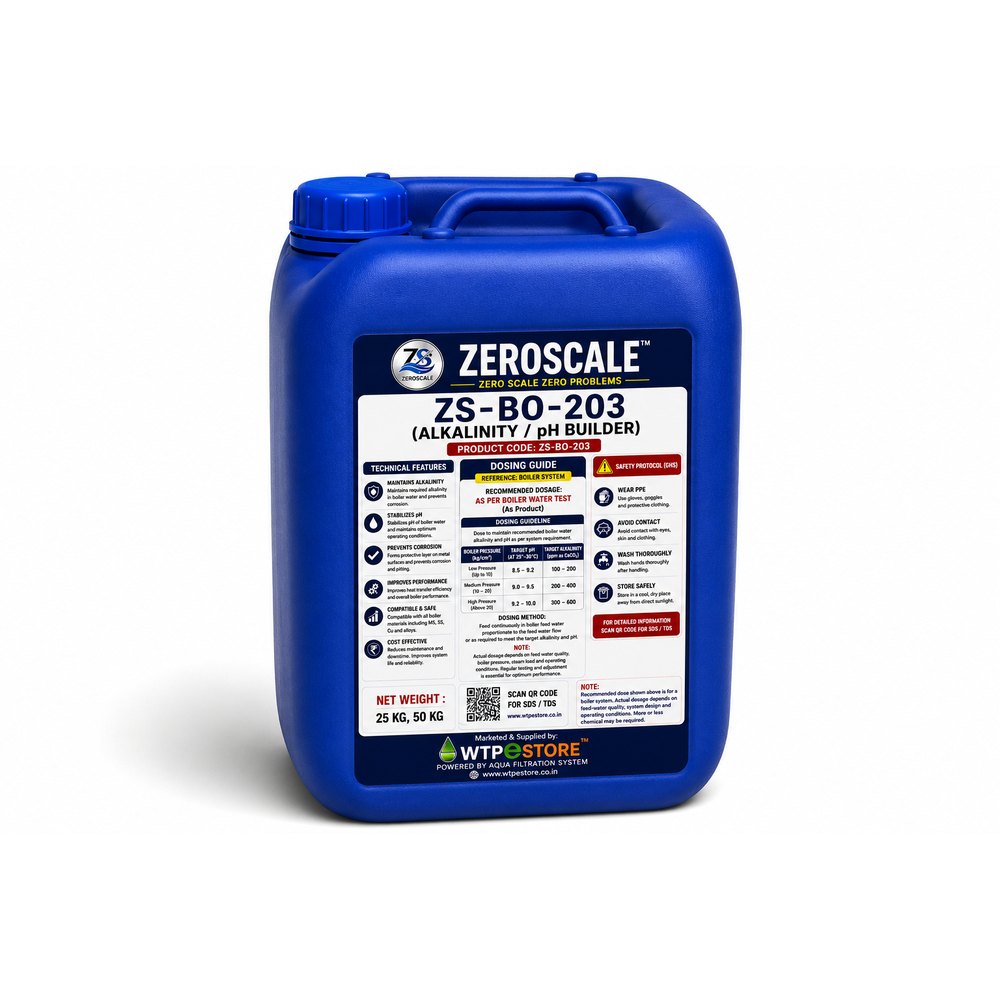
Boiler water sits in a narrow pH window. Too low and the metal corrodes; too high and you risk caustic embrittlement. This builder holds alkalinity and pH inside that window as load and make-up vary through the day.
Boiler water chemistry has a target range, and both sides of it cause damage. Drop below the range and the water turns acidic and corrosive, attacking tubes and drum surfaces generally. Push above it and free caustic concentrates at stressed points — around rolled tube ends, riveted seams and weld zones — where it causes caustic embrittlement, a form of cracking that gives almost no visible warning.
Holding the range is harder than it sounds because the water is constantly changing. Steam leaves, concentrating dissolved solids. Blowdown removes concentrate. Fresh make-up dilutes. Returning condensate can bring in carbonic acid from CO₂. pH moves through the day with the load pattern.
An alkalinity builder gives the water buffering capacity, so those swings move it far less than they otherwise would.
The builder adds controlled alkalinity with the buffering to hold it steady:
Correct alkalinity also lets the other treatment chemicals work as intended — sludge conditioning and oxygen scavenging both depend on boiler water sitting in the right pH range.
| Parameter | Detail |
|---|---|
| Product code | ZS-BO-203 |
| Type | Boiler alkalinity and pH builder |
| Function | Maintains boiler water alkalinity and pH in the recommended range |
| Dosage | As per boiler water TDS and pH results |
| Dosing point | Feed water line or directly to boiler drum |
| Control test | Daily boiler water pH and alkalinity |
| Pack size | 25 kg · 50 kg |
| Storage | Cool, dry, shaded — keep container closed |
Indicative — your boiler's pressure class sets the exact limits.
| Condition | Guideline |
|---|---|
| Boiler water pH | Maintain in recommended band for your pressure rating |
| If pH is falling | Increase dose; also check condensate for CO₂ ingress |
| If pH is climbing | Reduce dose; review blowdown rate |
| Boiler water TDS | Control by blowdown against the boiler limit |
| Test frequency | Daily as minimum; twice daily on variable load |
Standard chemical programme for industrial boilers across process industries.
Where returning CO₂ pushes boiler water pH down over time.
Where steam demand swings through the shift and water chemistry moves with it.
Where stressed joints make embrittlement control especially important.
The correct band depends on your boiler's operating pressure — higher pressure boilers run tighter limits. Tell us your boiler make, pressure and capacity and we will confirm the target range for your unit.
Cracking that develops where free caustic concentrates at stressed points such as rolled tube ends and seams. It progresses with little external warning, which is why controlled alkalinity — rather than simply high alkalinity — matters.
Usually carbon dioxide returning with the condensate, forming carbonic acid. A condensate corrosion inhibitor addresses the cause; raising the boiler dose alone only treats the symptom.
Daily as a minimum — pH, alkalinity and TDS together. Plants on swinging load benefit from twice-daily checks.
Caustic raises pH but adds no buffering, so the value swings back quickly and it is easy to overshoot into the embrittlement risk zone. A formulated builder holds the range far more steadily.
No. Blowdown controls dissolved solids; the builder controls pH and alkalinity. Skipping blowdown while dosing chemical concentrates everything in the boiler and makes control impossible.
Send us your water analysis and system details — we will work out the dose rate, monthly consumption and price for you.
