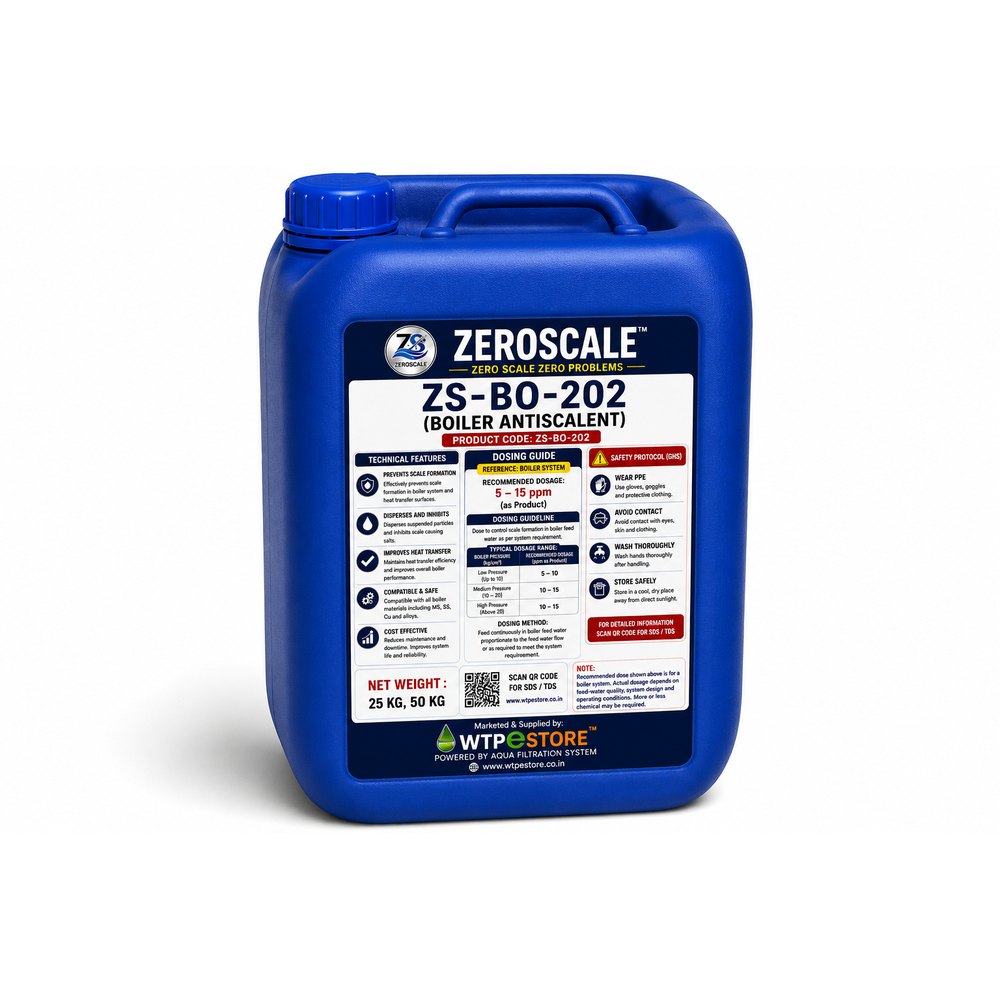
Softeners never remove hardness completely, and whatever slips through concentrates inside the boiler. This antiscalant turns that residual hardness into a loose sludge you can blow down — instead of hard scale bonded to the tubes.
Scale is an insulator. A layer barely a millimetre thick across the heat-transfer surface forces the burner to work noticeably harder to deliver the same steam — that is fuel money burnt every hour the boiler runs.
The second cost is worse. Scale insulates the tube metal from the water that is supposed to cool it, so the metal runs hotter than design. Sustained overheating leads to bulging, cracking and tube failure — and boiler tube failures mean unplanned shutdown at best.
The hardness causing it is what gets past the softener. A softener at the end of its cycle, a missed regeneration, or a brine system running short all let hardness slip through in exactly the amounts that build scale.
The antiscalant intercepts hardness before it can form an adherent deposit:
This is a second line of defence, not a replacement for softening. Keeping feed hardness low is still the first job — the antiscalant handles the residue that gets through.
| Parameter | Detail |
|---|---|
| Product code | ZS-BO-202 |
| Type | Liquid boiler antiscalant / sludge conditioner |
| Function | Prevents scale; conditions residual hardness into non-adherent sludge |
| Dosage | 5–15 ppm (as product) on feed water |
| Dosing point | Feed water line or feed tank |
| Requires | Regular blowdown to remove conditioned sludge |
| Pack size | 25 kg · 50 kg |
| Storage | Cool, dry, shaded — keep container closed |
As printed on the pack — confirm against boiler water testing.
| Condition | Guideline |
|---|---|
| Low pressure (up to 10 kg/cm²) | 5–10 ppm |
| Medium pressure (10–20 kg/cm²) | 10–15 ppm |
| High pressure (above 20 kg/cm²) | 10–15 ppm |
| Softener due for regeneration | Upper end — and fix the softener |
| High make-up ratio | Increase toward the upper end |
Standard protection where a softener supplies feed water — covering the hardness that slips through.
Where a large fraction of feed is fresh make-up rather than returned condensate.
Units already carrying some deposit, where preventing further build-up is critical.
Continuous-running boilers where scale directly shows up as higher fuel consumption.
5–15 ppm as product, set by your boiler pressure and feed hardness. Low pressure boilers sit at 5–10 ppm; medium and high pressure run 10–15 ppm. Send us your feed water report and boiler capacity and we will work out the daily quantity.
Yes, absolutely. The antiscalant handles residual hardness — a few ppm. It cannot cope with raw hard feed water. Softening comes first; this protects against what gets through.
Set the schedule by boiler water TDS against your boiler's recommended limit. Without blowdown the conditioned sludge stays inside and the treatment achieves nothing.
Higher fuel consumption for the same steam output is the usual first sign. Confirm it during your next shutdown inspection — deposits on the water side of tubes are visible directly.
No. This is preventive. Existing hard scale needs mechanical or acid cleaning during a shutdown — tell us the boiler type and deposit and we will advise.
They run together as a programme but should be dosed separately rather than mixed in one tank. We can lay out the dosing points and rates for your boiler.
Send us your water analysis and system details — we will work out the dose rate, monthly consumption and price for you.
